Noorania Method and Tajweed: Learning Pronunciation and Improving Quranic Recitation
In brief
This article explains how the Noorania Method integrates the teaching of tajweed (rules of correct Quranic recitation) in a natural and progressive manner. You will discover how each lesson of the Qaida Noorania introduces a specific tajweed rule (idgham, ikhfa, iqlab, ghunna, madd) through practical examples rather than abstract definitions.
We detail the main tajweed rules covered by the method and explain why this inductive approach facilitates memorization and automatic application when reading the Quran. Complementary exercises and advanced tajweed books are recommended to deepen each rule after mastering the Qaida.
The link between the Nourania Method and تجويد (tajwid - the art of reciting the Quran properly) is fundamental but often misunderstood. Many people think that Nourania and tajwid are two separate things.
In reality, the Nourania Method is the FOUNDATION of tajwid. This guide details how القاعدة النورانية naturally teaches you the rules of tajwid pronunciation, and how to deepen these skills.
Discover the specific rules covered, practical exercises, and the improvement plan to recite the Quran with elegance and correctness.

The Intrinsic Link Between Nourania and Tajwid
What exactly is tajwid?
The تجويد (tajwid) literally means "to make beautiful or excellent". It is the set of rules for correct pronunciation of the Quran. These rules are not arbitrary - they come from the Quran itself and from the prophetic tradition.
Tajwid covers:
- Correct articulation of each letter
- Correct placement of the tongue and lips
- Correct duration of sounds (long vs short)
- Rules for combining letters
How Nourania teaches tajwid without even mentioning it
When you learn the Nourania Method, you are already learning tajwid PRACTICALLY. You learn:
- How to articulate each letter correctly = مخارج الحروف (makharij al-huruf - articulation of letters)
- Guttural sounds like ع غ ح خ = tajwid skills
- How to pronounce long and short vowels = مد (madd - prolongation)
- How to pronounce nasalized letters = غنة (ghunna - nasalization)
Essentially, the Nourania Method teaches the FOUNDATIONS of tajwid.

The Nourania Method Applied To The Surahs Al-Baqara & Al-Imran
7,50 EUR
See the productTajweed Rules Covered by the Nourania Method
1. Makharij al-Huruf (Articulation of Letters)
The first rule of tajweed: each Arabic letter comes from a specific point of articulation in the mouth.
The Nourania Method teaches you to place your tongue and lips correctly:
- ب (ba) : lips closed
- ل (lam) : tongue against the upper teeth
- ع (ayn) : deep throat (guttural sound)
- ج (jeem) : middle of the mouth
After a few weeks of Nourania, this articulation becomes automatic and natural.
2. Madd (Prolongation of Sounds)
The مد (madd) means "to lengthen" or "to prolong". Certain vowels must be pronounced longer.
Types of madd covered by Nourania:
- مد الطبيعي (madd tabi) : natural prolongation = 1 unit of time
- مد الصلة (madd al-sila) : prolongation by connection = 2 - 4 units
- مد الممنوع من الصرف (madd of indeclinable nouns) = 2 - 6 units
Nourania teaches you these prolongations practically when you read the verses. You learn by listening rather than by theoretical memorization.
3. Ghunna (Nasalization)
The غنة (ghunna) is a nasal sound produced when the letters ن (nun) or م (meem) appear before certain combinations.
Example: منهم (minhum) is pronounced with a distinctive nasal sound.
The Nourania Method, by showing you these words, naturally teaches you this ghunna.
4. Shadda (Doubling of Consonants)
The ّ (shadda) means that the letter is doubled and pronounced with emphasis.
Example: السلام (assalam) vs الصحابة (as-sahaba)
Nourania explicitly covers shadda from the introductory units, making this rule clear and automatic.
5. Sukun and Other Diacritical Marks
The ـسكون (sukun) means that no vowel follows the letter. This changes the pronunciation.
Example: ذَلِك (zalika) vs ذِلْك (zilk)
Nourania teaches all these marks from the beginning, so you never forget them.
Practical Exercises to Improve Recitation
Exercise 1: Slow and Precise Pronunciation (30 minutes)
Objective: Articulate each letter perfectly.
How to:
- Choose a simple verse (e.g. Al-Fatiha, the first surah)
- Read it VERY SLOWLY - one letter at a time
- Feel the position of your tongue and lips
- Listen to yourself - detect imperfections
- Compare with a professional recitation
- Correct the problematic articulation
- Repeat this verse 5 - 10 times slowly
Frequency: 3 - 4 times per week. This slow work builds good habits.
Exercise 2: Shadowing (Following a Professional)
Objective: Perfectly imitate the pronunciation of an expert reciter.
How to:
- Listen to a professional قارئ (qari - reciter)
- While listening, practice at the same time
- Try to pronounce exactly like him
- Listen to the same verse multiple times
- Each listening = one shadowing practice
Shadowing trains your ear to recognize the subtle nuances of tajweed.
Exercise 3: Recording and Self-Correction
Objective: Hear yourself reciting and identify errors.
How to:
- Record yourself reading a verse
- Listen to the recording
- Compare with a professional recitation
- Note the differences
- Recite again while correcting these points
- Re-record and re-compare
Frequency: Once per week. It is very revealing to listen to your own pronunciation.
Exercise 4: Focus on Difficult Sounds
Objective: Master the guttural letters and other complex sounds.
Difficult sounds for French speakers:
- ح (ha): Deep guttural sound
- خ (kha): Sound like Spanish jota
- ع (ayn): Resembles a closing throat
- غ (ghain): Like the French guttural "r"
Exercise:
- Isolate these letters
- Listen to how they are pronounced 10 - 20 times
- Feel the position of your throat and tongue
- Pronounce each one 20 - 50 times
- Then, practice words containing these letters
- Finally, practice complete verses
This is the most difficult but most important exercise. Allocate 1 - 2 full weeks on these sounds.

Al-Qaida An-Noraniah - juzz Tabaraka
5,00 EUR
View the product30-Day Improvement Plan
Week 1: Foundations
Focus: Articulate isolated letters correctly.
- Day 1 - 2: Listen and practice simple letters (ba, ta, tha)
- Day 3 - 4: Similar letters (ra, zay)
- Day 5 - 6: Guttural sounds (ha, kha, ayn, ghain)
- Day 7: General revision
Exercises: Slow pronunciation, repetition, active listening.
Daily duration: 20 - 30 minutes.
Week 2: Combinations and Syllables
Focus: Assemble letters into syllables respecting tajweed.
- Day 8 - 10: Simple syllables with short vowels
- Day 11 - 12: Syllables with prolongations (madd)
- Day 13 - 14: Syllables with shadda and sukun
Exercises: Professional shadowing, recording.
Daily duration: 30 - 40 minutes.
Week 3: Complete Words and Simple Verses
Focus: Recite complete words and short verses with correct tajweed.
- Day 15 - 17: Simple Quranic words
- Day 18 - 19: Short verses (Fatiha, first surahs)
- Day 20 - 21: Revision and consolidation
Exercises: Slow reading, recording and self-correction.
Daily duration: 40 - 50 minutes.
Week 4: Long Verses and Fluency
Focus: Recite fluently while maintaining correct tajweed.
- Day 22 - 24: Longer verses
- Day 25 - 26: Complete juzz (1/30th of the Quran)
- Day 27 - 30: General revision, correction of details
Exercises: Fluent shadowing, regular recitation.
Daily duration: 45 - 60 minutes.

When to move to a dedicated tajwid manual
After mastering the Nourania Method (4 - 8 weeks), you can consider more specialized tajwid manuals:
Level 1: After basic Nourania
Tutmaan al-Quraan (the tranquility of the Qur'an) or Al-Juzriyya - mnemonic poems on the rules of tajwid.
Prerequisites: You must already read the Qur'an fluently with Nourania.
Level 2: In-depth study
Study the 70+ detailed tajwid rules with Qur'anic examples.
Prerequisites: 1 - 2 months of basic tajwid + mastered Nourania.
Level 3: Expertise
Recitation according to a specific school of reading (Hafs, Warch, Qalun, etc.) with all the details.
Prerequisites: 3 - 6 months of tajwid study + mentorship from an experienced qari.
FAQ: Tajwid and Nourania
Should I study tajwid before or after Nourania?
Start with Nourania first. Nourania TEACHES tajwid practically. After 4 - 8 weeks of Nourania, you already understand the main rules. Then, study tajwid theoretically to deepen and memorize the 70+ rules.
Does reciting the Quran correctly change according to the schools of recitation?
Yes and no. The fundamentals of tajwid are identical (articulation, madd, ghunna). The differences between Hafs, Warch, etc., are subtle - a few words are pronounced slightly differently. After mastering Hafs (the most common), switching to another school is easy.
How long does it take to master tajwid completely?
Basic mastery (sufficient for correct recitation): 2 - 3 months. Advanced mastery: 1 - 2 years. Expertise (professional qari): 5 - 10 years. There is no "end" - even famous reciters continuously improve.
Is there a difference between "complete" and "basic" tajwid?
Basic tajwid: approximately 10 - 15 main rules that Nourania covers. Complete tajwid: 70+ rules with special cases. To recite the Quran correctly, the basic is sufficient. The complete is for those desiring absolute excellence or professional teaching.
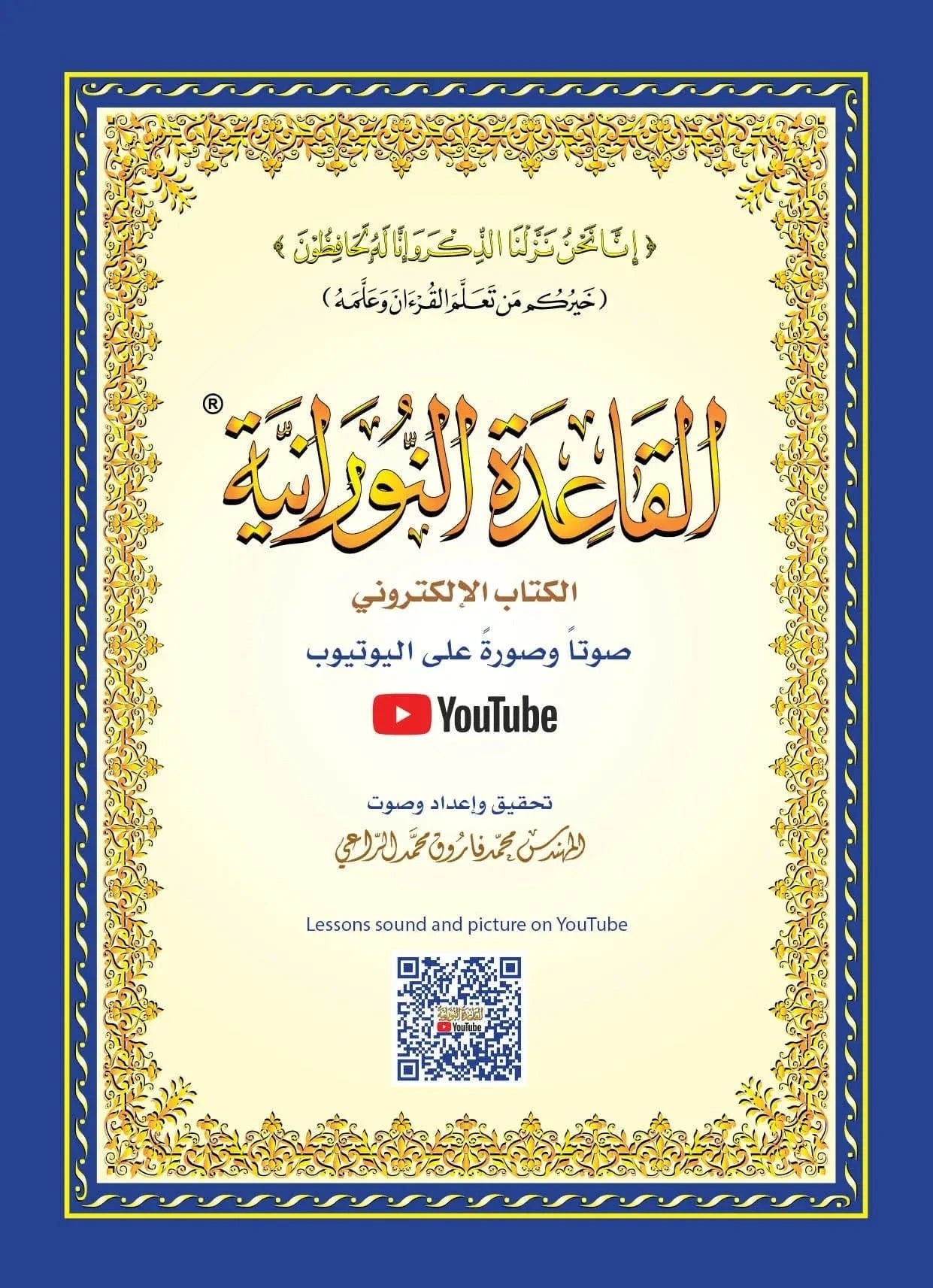
Do the QR codes in the Nourania book still work?
The QR codes in recent editions (15th edition and onwards) generally direct to YouTube videos or publisher platforms. They remain functional as long as the publisher maintains the links. If a QR code no longer works, you can search for the corresponding lesson on YouTube using the keywords "Qaida Nourania lesson [number]". The official audio recordings of Sheikh Haqqani remain the reference.
Can you learn Nourania only with YouTube videos?
YouTube videos are an excellent complement, but do not replace the book. The book offers structured progression lesson by lesson, with reading exercises that video alone does not allow you to practice. The ideal is to combine the printed book for visual exercises, audio for pronunciation, and video to see mouth movements when articulating letters.
Key Takeaways
- The Nourania Method does not replace tajwid, but it forms its foundation. By mastering Nourania, you already master 50 - 60% of tajwid. After that, deepening with specific exercises and possibly a teacher leads you to a magnificent recitation of the Quran.
- Start by acquiring your Nourania Method book, then progress towards tajwid. Discover our specialized audio resources and explore the complete collection for all your educational needs.
Apply these concepts to strengthen your understanding and progress in your learning journey.
The Nourania Method does not replace tajwid, but it forms its foundation. By mastering Nourania, you already master 50 - 60% of tajwid. After that, deepening with specific exercises and possibly a teacher leads you to a magnificent recitation of the Quran.
Start by acquiring your Nourania Method book, then progress towards tajwid. Discover our specialized audio resources and explore the complete collection for all your educational needs.
Main Guide
Related Articles
📚 Also Read
−5 % off the entire library with code BLOG5
Valid on the entire site, no minimum purchase required — our thanks to blog readers.
Discover the selection