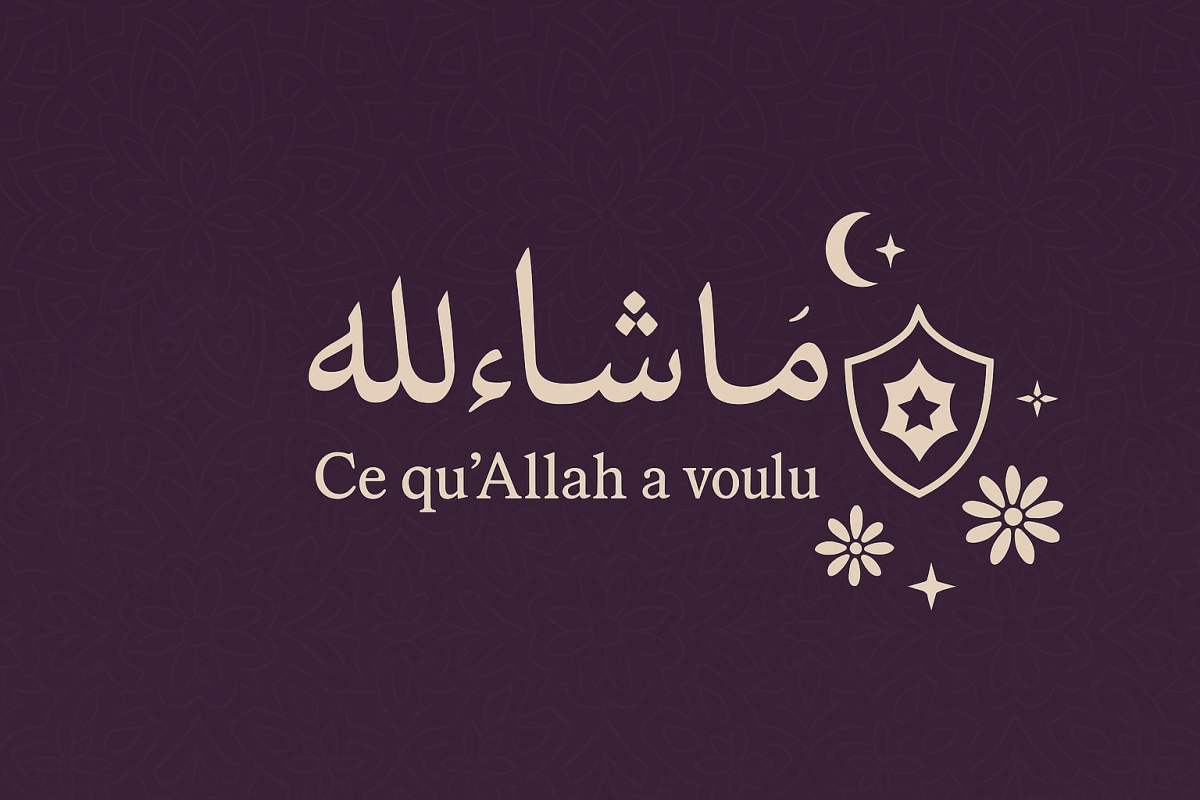
MashaAllah means What Allah has willed in Arabic. This Islamic expression serves to express admiration while recognizing divine will and symbolically protects from the evil eye. Mentioned in the Quran (Surah Al-Kahf 18:39), it is used in response to a success, beauty, or blessing.
Its correct pronunciation is Maa shaa Allah and not Mashallah (which would mean Allah walked). You can respond with Barakallah, Ameen, or Jazak Allah khayran. MashaAllah concerns the present or past, unlike Inchallah (future) or Alhamdulillah (gratitude).
An Expression Rich in Wisdom
In Islamic tradition, expressions that recognize Allah's sovereignty are numerous and constitute a rich spiritual vocabulary that punctuates the daily life of believers. Among these precious formulas, "MashaAllah" (ما شاء الله) holds a special place, combining admiration with recognition of divine will.
This expression, which literally means "What Allah has willed", is not merely a polite formula. It embodies profound spiritual wisdom: recognizing that all beauty, all success and all excellence ultimately come from Allah. Beyond its literal meaning, it is also considered a protection against the evil eye, in accordance with prophetic teachings.
Through this article, we will explore the multiple dimensions of this expression, its Quranic foundations, its appropriate contexts of use, and how it articulates with other similar Islamic formulas.

Meaning and Spiritual Foundations
The Linguistic and Spiritual Scope
The expression "MashaAllah" (ما شاء الله) is composed of three elements in Arabic:
- "Ma" (ما) : "What"
- "Shaa" (شاء) : "Willed"
- "Allah" (الله) : "God"
Its literal meaning is therefore "What Allah has willed", but its spiritual scope is much richer. This formula acknowledges the primacy of divine will in everything that exists or manifests itself in the world. It affirms that nothing happens without Allah's permission, that everything that amazes us is first and foremost the fruit of His will.
It is important to note the correct pronunciation: "Maa shaa Allah" with a vocal extension on the first "a". The common contraction "Mashallah" can be problematic because it could be confused with an expression meaning "Allah walked", which would be theologically incorrect.
Foundations in the Quran and the Sunnah
This expression finds its origin in the Noble Quran, particularly in Surah Al-Kahf (The Cave), where Allah says:
"Why did you not say, when you entered your garden: 'MashaAllah! There is no power except in Allah'" (Quran 18:39)
This verse is part of a parable in which a wealthy man boasts of his riches without acknowledging that they come from Allah. The Quran thus teaches us that saying "MashaAllah" is a way of recognizing the divine origin of all blessings and protecting ourselves from pride.
In the Sunnah, many hadiths emphasize the importance of this expression. The Prophet Muhammad ﷺ said:
"Whoever sees something in his brother or in himself or in his possessions that pleases him and says: 'MashaAllah, la quwwata illa billah' (What Allah has willed, there is no power except in Allah), will not cause him harm." [Reported by Ibn as-Sunni]
This hadith clearly establishes the link between "MashaAllah" and protection against the evil eye (al-'ayn), that involuntary negative influence that untempered admiration can have when not accompanied by recognition of divine supremacy.
Appropriate Contexts of Use
To Express Admiration
"MashaAllah" is naturally used in situations where one feels admiration or wonder, for example:
- Faced with the beauty of a child or a creation
- Upon noticing someone's success or achievement
- Upon discovering an exceptional talent or quality
- While admiring a work, landscape or accomplishment
The use of "MashaAllah" in these contexts allows one to express admiration while:
- Acknowledging that this beauty or excellence comes from Allah
- Protecting what one admires from the evil eye
- Sharing one's joy within a spiritual framework
To Protect Oneself from the Evil Eye
The concept of the evil eye (al-'ayn) is well established in Islamic tradition. The Prophet Muhammad ﷺ confirmed its reality by saying:
"The evil eye is a reality." [Reported by Al-Bukhari and Muslim]
"MashaAllah" serves as spiritual protection because it:
- Explicitly attributes to Allah the source of what is admired
- Reminds the one who uses it that everything belongs to Allah
- Protects the object of admiration by invoking divine will
It is recommended to use it particularly:
- When admiring one's own possessions or qualities
- Faced with particularly precious people or possessions
- When complimenting someone
Differences with Other Similar Expressions
MashaAllah vs Inchallah
These two common Islamic expressions are sometimes confused but have very distinct uses:
-
MashaAllah (ما شاء الله) : "As Allah has willed"
- Applies to the present or past
- Expresses admiration or appreciation
- Example: "MashaAllah, your work is excellent"
-
Inchallah (إن شاء الله) : "If Allah wills"
- Applies to the future
- Expresses intention or hope, submitted to divine will
- Example: "I will pass my exam, Inchallah"
MashaAllah vs Alhamdulillah
Similarly, these expressions have important nuances:
- MashaAllah : Admiration, recognition of divine will
- Alhamdulillah (الحمد لله) : "Praise be to Allah", expression of gratitude for a blessing received
One might say "MashaAllah" while admiring someone else's house, but "Alhamdulillah" after receiving one's own house.
MashaAllah vs Tabarakallah
Another interesting distinction:
- MashaAllah : Emphasizes divine will behind what is admirable
- Tabarakallah (تبارك الله) : "May Allah bless", emphasizes divine blessing and explicitly calls for blessings upon what is admired
These nuances illustrate the richness of Islamic spiritual vocabulary, where each expression has its specific function and appropriate context.
Spiritual Benefits and Divine Protection
Strengthening of Faith (Iman)
The regular and conscious use of "MashaAllah" strengthens several aspects of Islamic faith:
- Tawhid: It affirms that Allah is the ultimate source of everything that exists
- Tawakkul: It reinforces trust in Allah and submission to His will
- Shukr: It encourages gratitude to Allah for all blessings
Protection Against the Evil Eye and Envy
Islamic tradition recognizes the power of the evil eye, this involuntary negative influence that can result from admiration not accompanied by divine recognition. "MashaAllah" constitutes effective protection because:
- It transforms potentially harmful admiration into spiritual gratitude
- It implicitly invokes Allah's protection over what is admired
- It reminds us that everything is subject to divine will, thus diminishing the impact of envy
The Prophet Muhammad ﷺ said:
"The evil eye is real and if there were anything that could precede destiny, it would be the evil eye." [Reported by Muslim]
Fighting Against Pride and Arrogance
By using "MashaAllah", the believer:
- Acknowledges that his own qualities and successes come from Allah
- Protects himself against the pride of attributing exclusive merit for his successes
- Develops humility by recognizing the divine source of all excellence
How to Respond to "MashaAllah"
Appropriate Responses
When this invocation is addressed to you, several responses are appropriate:
- "Ameen" (آمين) - "Amen", which means "O Allah, grant this supplication"
- "Barakallah fik" (بارك الله فيك) - "May Allah bless you"
- "Jazak Allahu khayran" (جزاك الله خيرا) - "May Allah reward you with good"
These responses express gratitude for the kindness expressed and strengthen the fraternal bond between Muslims.
Complementary Phrases
To reinforce the protective effect of "MashaAllah", you can add:
-
"La quwwata illa billah" (لا قوة إلا بالله) - "There is no strength except in Allah" This combination is particularly recommended in the hadith previously mentioned.
-
"Tabarak Allah" (تبارك الله) - "Blessed be Allah" This addition emphasizes the divine blessing present in what is admired.

Application In Daily Life
Integrating "MashaAllah" Into Your Daily Life
For this expression to become a natural part of your spiritual vocabulary:
- Get into the habit of saying "MashaAllah" when faced with what amazes you
- Use it when you compliment someone
- Teach its usage and meaning to children
- Pronounce it when faced with blessings in your own life
Avoiding Common Mistakes
A few precautions to take for respectful and beneficial use:
- Correct pronunciation: "Maa shaa Allah" and not "Mashallah" (without vocal elongation)
- Sincere intention: Avoid using it as a mere cultural expression emptied of its meaning
- Appropriate contextualization: Use it in situations that truly deserve admiration
- Consistency with actions: Accompany this expression with behavior that reflects gratitude towards Allah
Frequently Asked Questions
Can a non-Muslim say "MashaAllah"?
Yes, there is no prohibition for a non-Muslim to use this expression, especially in a multicultural context where it can be adopted out of respect for Islamic culture. However, it is preferable that they understand its spiritual meaning. For a Muslim, hearing a non-Muslim say "MashaAllah" is generally not problematic and can even be appreciated as a gesture of respect toward cultural and religious sensitivities.
What is the difference between "MashaAllah" and "Tabarakallah"?
Although often used in similar contexts of admiration, these expressions have different nuances:
- "MashaAllah" emphasizes the divine will that permitted the existence of what is admired
- "Tabarakallah" underscores the divine blessing present in what is admired and explicitly calls upon these blessings
Both can be used together or separately depending on the context.
Should "MashaAllah" only be said for great things?
No, "MashaAllah" can and should be used to recognize divine will in all positive things, great or small. Whether it is to admire a simple sunset, a child's progress in their studies, or a major professional achievement, this expression reminds us that all good comes from Allah.
An Expression That Enriches Spiritual Life
The expression "MashaAllah" perfectly embodies the way Islam integrates spirituality into every aspect of daily life. It transforms an ordinary moment of admiration into a recognition of divine will, and simultaneously offers protection against the potentially negative effects of untempered admiration.
By using this expression regularly and consciously, the believer cultivates humility, gratitude, and awareness of divine presence in all aspects of existence. "MashaAllah" thus becomes much more than a simple cultural formula: it is a daily spiritual exercise that strengthens the relationship with Allah.
To deepen your understanding of Islamic expressions and their place in Muslim spirituality, we invite you to explore our collection of works on faith and spirituality and on Islamic vocabulary available in our bookstore.
📚 Also read
−5 % off the entire bookstore with code BLOG5
Valid on the entire site, no minimum purchase — our thanks to blog readers.
Discover the selection