Quranic Arabic: Books to Understand the Vocabulary and Structures of the Quran
In Brief
This specialized guide accompanies you in learning Quranic Arabic, the language of the Quran and sacred texts of Islam. You will understand the differences between classical Quranic Arabic and modern standard Arabic, the specific vocabulary of the Quran (the 300 most frequent words cover 70% of the text), and the essential grammar rules to understand the verses without translation. Also discover our article on Quran Hafs.
We compare the most renowned Quranic Arabic manuals, works for absolute beginners to advanced linguistic analyses. Study programs over 6 and 12 months guide you toward autonomous understanding of the Quran. Find the Quranic Arabic book suited to your level at Al-Imen. Also discover our article on Buy Quranic Book.
Quranic Arabic represents the pure and timeless essence of the Arabic language. Learning to understand the Quran in Arabic requires much more than a simple grammatical understanding. It is a dive into the very heart of Islam, a direct connection with the divine word.
This guide shows you how to master frequent vocabulary, recurring structures and the particularities of Quranic Arabic through the best learning resources available at Al-Imen.

What are the differences between Quranic Arabic and Modern Standard Arabic?
A fundamental question arises for every serious student: how does Quranic Arabic differ from the modern Arabic you would see on television or in contemporary newspapers? The answer is crucial for guiding your learning approach.
Quranic Arabic, called classical Arabic or (عربية قرآنية - 'arabiyya qur'aniyya), is also known as classical fusha (فصحى - fusha). It is the most elevated and most precise form of the Arabic language.
Quranic Arabic is characterized by highly systematic and precise grammar, archaic yet very precise vocabulary, distinct rhetorical and stylistic structures, and a complete absence of modern vocabulary.
By contrast, Modern Standard Arabic (الفصحى الحديثة - al-fusha al-haditha) borrows contemporary terms, uses simplified grammar for practical communication, and adopts more accessible language for media and recent literature.
Here is a detailed comparison between the two:
| Aspect | Quranic Arabic (Classical) | Modern Standard Arabic |
|---|---|---|
| Period of usage | 7th century, timeless | 19th-21st centuries |
| Grammar | Strict, every letter has a role | Simplified, adapted for contemporary use |
| Vocabulary | Classical, mainly semantic | Includes modern terms: computer, television, internet |
| Rhetorical structures | Linguistic beauty, i'jaz (inimitability) | Clarity and communicative effectiveness |
| Pronouns and particles | More numerous and precise | Reduced, varying by region |
| Example: Water | ماء (ma') | ماء (ma') - same word, identical usage |
| Example: Computer | Does not exist | حاسوب (hasub) or كمبيوتر (kumbyutr) |
The crucial importance is that the Quran uses very precise grammatical structures, verbs linked to roots with profound meanings, and intentional repetitions of key words. Understanding the Quran therefore means mastering these particularities of classical Arabic.
Fortunately, learning Quranic Arabic also allows you to understand the majority of classical Arabic literature, pre-Islamic poetry, and hadith texts.
What are the most frequent words in the Quran and how to learn them?
Here is a fascinating reality: approximately 300 distinct words in the Quran represent about 70% of all Quranic text. This means that if you master the 300 most frequent words in the Quran, you can understand nearly three-quarters of the sacred text.
This is a powerful statistic that makes intensive learning of Quranic vocabulary extremely effective. The word frequency approach, or tadkir al-kalimat (تذكر الكلمات), is one of the smartest strategies to accelerate your understanding.
Quranic vocabulary can be categorized into several groups. Particles (حروف - huruf) are words that connect other words: في (fi - in), من (min - from), إلى (ila - towards), على ('ala - on).
Pronouns (ضمائر - dama'ir) refer to persons: أنا (ana - I), أنت (anta - you), هو (huwa - he), هي (hiya - she), نحن (nahnu - we).
Verbs (أفعال - af'al) express actions: قال (qala - to say), فعل (fa'ala - to do), علم ('alima - to know). Nouns (أسماء - asma') designate things: الله (Allah - God), كتاب (kitab - book), إنسان (insan - human).
To learn these words effectively, organize them by decreasing frequency. Start with the 50 most common words, then progress to 100, 300, up to 1000 words. Each word must be studied with its morphological variations, its Quranic contexts, and its etymological roots.
Use digital or physical vocabulary flashcards, repeat daily, and immerse yourself in verses containing these words.
Specialized Quranic lexicons, such as those from Learning Roots or Maison d'Ennour, offer exactly this category of words organized by frequency. They accompany each word with verse examples, pronunciations, and detailed definitions.
This is the essential tool to accelerate your progress.
Build your Quranic vocabulary with the best playful method
Iqra - Playful Method of Quranic Reading - Medina Typography
A progressive and playful method that teaches you to read the Quran in Arabic, with clear Medina typography. Perfect for anchoring your learning of Quranic vocabulary through authentic reading.
See the productHow to Analyze Recurring Grammatical Structures in the Qur'an?
Beyond simple vocabulary, the Qur'an presents highly sophisticated and intentional grammatical structures. One of the keys to understanding the divine message is recognizing these recurring structures. Prepositions (حروف الجر - huruf al-jar) play a central role in constructing meaning in Qur'anic Arabic.
The five most frequent prepositions in the Qur'an are: في (fi - in/at), من (min - from), إلى (ila - towards/to), على ('ala - on/about), and ب (bi - with/by).
Each of these prepositions modifies the meaning of a Qur'anic sentence radically. For example, in Surah Al-Fatihah (The Opening), we find الحمد لله (al-hamdu liliah - all praise belongs to Allah).
The preposition ل (li) here is not mere possession, but rather indicates that praise is due to Allah by divine nature. Changing this preposition would completely alter the theological meaning.
Pronouns, particularly attached pronouns (الضمائر المتصلة - al-dama'ir al-muttasila), and detached pronouns (الضمائر المنفصلة - al-dama'ir al-munfasila), function differently in Arabic than in French. An attached pronoun is added directly to the verb or noun: كتابي (kitabi - my book).
A detached pronoun stands alone: أنا (ana - I). The Qur'an employs both forms strategically to create subtle nuances of meaning.
Recurring verbal patterns, or verbal forms (صيغ - suygha), repeat schemas that echo a central message. For example, Surah Al-Rahman (The Most Merciful) repeats the refrain فبأي آلاء ربكما تكذبان (fa-bi-ayyi alai rabbikuma tukadhdhiban - which then of the favors of your Lord will you deny?).
This intentional repetition creates a rhythm that reinforces the message. Analyzing Qur'anic Arabic means identifying these repetitions and understanding their rhetorical purpose.
Complete grammatical analysis, or i'rab (إعراب), dissects every word in its sentence, identifying its grammatical function, its case (nominative, accusative, genitive), its gender and number. I'rab is a specialized skill that requires time but completely transforms your understanding of the Qur'an.
Structure, or tarkib (تركيب), concerns how sentences come together to communicate complex ideas.
Master the structures of the Qur'an with a practical guide
The Holy Qur'an - Juz' Amma Arabic French Phonetic
A practical edition of Juz' Amma (the last thirtieth part) with transliteration and translation, ideal for studying recurring structures on short and frequently recited surahs.
View the productWhat study plan should be adopted to understand the Quran in Arabic gradually?
Learning to understand the Quran in Arabic is a quest that requires structure, patience and perseverance. The most effective approach follows a deliberate progression plan, starting with the most accessible parts and gradually advancing towards more complex texts.
This requires a methodical strategy that values constant consolidation of previous knowledge.
Phase 1: Beginning with Juz' Amma (the last 30 chapters)
Juz' Amma, composed of short and spiritually powerful chapters of the Quran, represents the ideal starting point. These surahs contain repeated vocabulary and impactful messages that quickly implant key words in your mind.
Start with Surah Al-'Asr (Time), the shortest after Al-Kawther, and analyze it word by word. والعصر (wa-al-'asr - by the time). إن الإنسان لفي خسر (inna al-insan lafiy khusr - Man is indeed in loss).
Each word already begins to teach you roots and fundamental structures.
Phase 2: Build a foundation of 300 frequent words
While studying Juz' Amma, simultaneously compile a list of the 300 most frequent words of the complete Quran. Learn their roots, their variations, and their occurrence in different contexts.
This parallel approach accelerates your word recognition in subsequent passages.
Phase 3: Progression towards longer Surahs
Once Juz' Amma is mastered, move to longer chapters but still relatively short ones like Luqman, Al-Kahf, Yusuf. These surahs contain narratives that strengthen your grammatical understanding while immersing you in Quranic vocabulary.
The use of tadabbur (تدبر), or contemplative reflection on the Quran, becomes richer when you understand each word.
Phase 4: Verse-by-verse technique
For each verse you analyze, follow this method:
- Read the entire verse aloud several times to immerse yourself in the rhythm and pronunciation.
- Identify each word and its form: verb, noun, particle, etc.
- Search for the root of each word (except invariable particles).
- Study the grammar: case, gender, number, function in the sentence.
- Consult a tafsir (Quranic interpretation) to understand the deeper meaning.
- Repeat the verse several times until you can recite and understand it without reference.
Fahm (فهم - understanding) and tadabbur (تدبر - reflection/meditation) are the two pillars of this process. Understanding concerns the literal and grammatical meaning, while reflection concerns theological wisdom and spiritual lessons.
Both are essential for a complete study of the Quran.
Complete Study Plan: Memorization and Understanding Combined
Learning to understand the Quran is not limited to reading. For many sincere learners, memorization accompanied by deep understanding is the ultimate goal. A simplified memorization method, such as the one presented in Al-Hifdh Al-Muyassar, allows you to combine learning the sacred text with progressive understanding of each verse.
This approach ensures that you do not memorize mechanically, but rather build a living and comprehensible relationship with the divine message.
Quran Al-Hifdh Al-Muyassar - Simplified Memorization Method
A special edition designed to facilitate progressive memorization of the Quran with clear presentation and proven methodology.
Start now
How do tajwid and recitation complement the learning of Quranic Arabic?
The tajwid (تجويد), which literally means improvement or beautification, is the art and science of correct recitation of the Quran. It encompasses the rules of pronunciation, fluidity, rhythm, and emotion.
Learning tajwid is not separate from learning Quranic Arabic; it is an intrinsic part of understanding and appreciating the sacred text.
The rules of tajwid teach how each letter must be pronounced, how certain letters connect with one another, how long and short vowels differ, and how stops and pauses affect meaning.
For example, the rule of النون الساكنة والتنوين (al-nun al-sakina and al-tanwin - the quiescent nun and nunation) specifies how these sounds interact with the following letters. This linguistic precision refines your understanding of the phonetic and grammatical structure of the Quran.
The tilawa (تلاوة - recitation) is the act of reciting the Quran beautifully and correctly. The authentic recitation, that of the Prophet Muhammad (peace be upon him) as transmitted by the masters of recitation, has been preserved for more than 1400 years.
By learning tajwid, you become part of this unbroken chain of transmission. You are not merely pronouncing words; you are connecting with a living tradition of learning and spirituality.
The study of tajwid and tilawa also strengthens your auditory memory and your perception of linguistic nuances. The smallest variations in pronunciation often reveal hidden messages and communal intentions.
The Quran itself was revealed orally to the Prophet Muhammad, and this oral nature must be preserved in your learning.
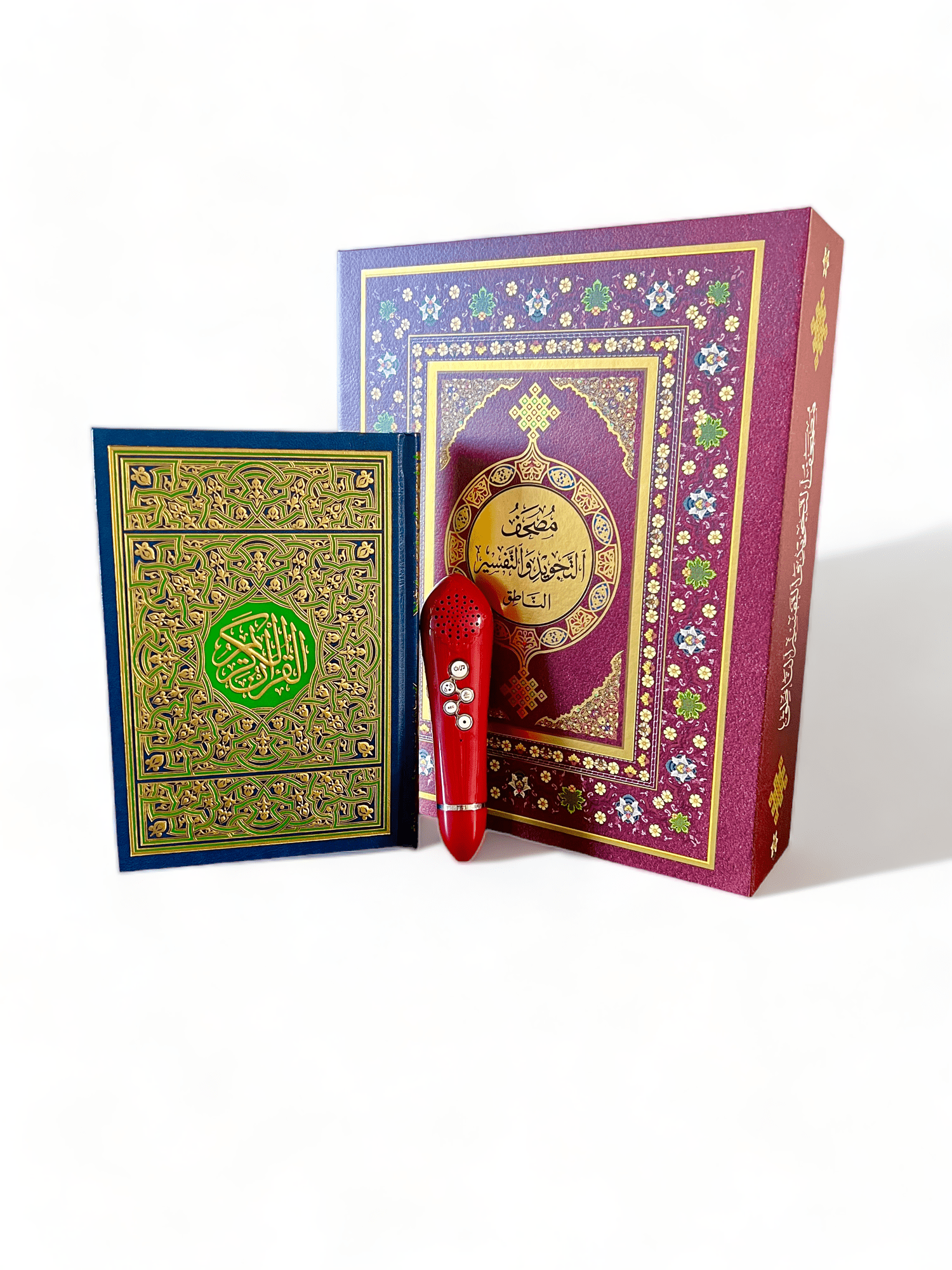
To deepen your study of Quranic Arabic, explore our specialized collections in Nourania (Quranic reading methods) and Tafsir (scholarly interpretations of the Quran). These combined resources offer a holistic approach that strengthens your grammatical understanding, vocabulary, and spiritual appreciation of the sacred text.
What are the delivery times for my books?
Al-Imen delivers in mainland France within 2 to 5 business days. For Belgium and Europe, allow 5 to 10 days. Consult our shipping and delivery page for detailed rates and order tracking options.
Frequently Asked Questions About Quranic Arabic
Can you understand the Quran without studying Arabic grammar?
Technically, yes, you can grasp a general understanding of the Quran with a translation and without studying grammar. However, this approach deprives you of the depth and precision of the divine message.
Every verb, every particle, every word order in the Quran has been deliberately chosen. Arabic grammar, particularly nahw (syntax) and sarf (morphology), is the key to unlocking the multiple layers of meaning.
Learning grammar transforms your understanding from superficial to profound.
How long does it take to understand the Quran in Arabic?
The duration varies depending on your starting point and commitment. A beginner can start to understand short surahs from Juz' Amma in 3 to 6 months of intensive study.
For fluent understanding of the complete Quran, plan for 2 to 3 years of systematic and regular study. People who learn reading (tajweed) and grammar simultaneously often progress faster because these skills reinforce each other.
The key is consistency: 30 to 60 minutes of daily study produces much faster results than long and irregular sessions.
Does the Nourania method help with understanding Quranic Arabic?
The Nourania method is primarily a Quranic reading method (tajweed), not detailed teaching of Quranic grammar or vocabulary. However, it is extraordinarily useful as a complement.
By learning to read the Quran correctly with Nourania, you strengthen your visual recognition of words, your authentic pronunciation, and your emotional connection to the text. This creates a solid foundation for subsequent grammatical learning.
The ideal approach combines Nourania for recitation with detailed grammatical and vocabulary studies.
Must you learn modern Arabic before Quranic Arabic?
No, not necessarily. In fact, many sincere learners start directly with Quranic Arabic because it is their primary spiritual objective. However, there is a logical advantage to learning the basics of Arabic grammar (fundamental nahw and sarf) independently of the period—classical or modern—before diving into detailed Quranic study.
These basics are universal. Once you understand how roots, patterns, and basic syntax work, you can immediately apply them to the Quran. Some learners find that Quranic Arabic is actually more logical and systematic than modern Arabic, making it easier rather than harder to start with the Quran.
What is the best book to start with Quranic Arabic?
The "best" book depends on your situation. For someone with no Arabic background, start with a reading method like Iqra or Nourania to learn how to read Arabic text.
Next, move to a practical edition of Juz' Amma with transliterations and translations (such as the Quran from Maison d'Ennour). In parallel, study a fundamental Arabic grammar manual. For a learner with basic Arabic knowledge, Quranic lexicons and Quranic analysis guides are more appropriate.
Al-Hifdh Al-Muyassar Quran combines memorization and understanding, making it an excellent choice for those who wish to progress quickly in both areas simultaneously.
Main guide
Related articles
📚 Also read
−5 % off the entire bookstore with code BLOG5
Valid on the entire site, with no minimum purchase — our thanks to blog readers.
Discover the selection